| Languages of Italy | |
|---|---|
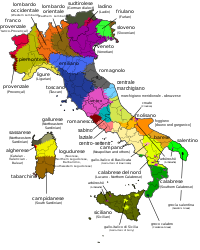 Intuitive map of languages and dialects of Italy |
|
| Official language(s) | Italian |
| Regional language(s) | official
French, German |
| Minority language(s) | officially recognized
Sardinian, Friulian (Rhaeto-Romance), Occitan, Albanian, Franco-Provençal, Slovene, Ladin, Griko, Alguerese (Catalan), Molise Slavic dialect (Croatian) |
| Main foreign language(s) | English (25%) Spanish (17%) French (14%) |
| Common keyboard layout(s) | |
| Source | ebs_243_en.pdf |
The official language of Italy is Standard Italian[1], a descendant of the Tuscan dialect and a direct descendant of Latin (some 75% of Italian words are of Latin origin), but several regional languages are also spoken to varying degrees. Other languages are spoken by a substantial percentage of the population due to immigration.
Contents[hide]
|
The Italian language since unification
The Tuscan dialect (or Florentine dialect) spoken in Tuscany was promoted as the standard due to the socio-economic power associated with Florence as well as its literary heritage (Dante's Divine Comedy is often credited with the emergence of the Tuscan dialect as a standard). Pietro Bembo, a Venetian influenced by Petrarch, also promoted Tuscan as the standard literary language (volgare illustre). The spread of the printing press and literary movements (such as petrarchism and bembismo) also furthered Italian standardization.
When Italy was unified in 1861, Italian existed mainly as a literary language. Many Romance regional languages were spoken throughout the Italian Peninsula (Italian dialects), each with local variants. Following Italian unification Massimo Taparelli, marquis d'Azeglio, one of Cavour's ministers, is said to have stated that having created Italy, all that remained was to create Italians (a national identity).
The establishment of a national education system led to a decrease in variation in the languages spoken across the country. Standardization was further expanded in the 1950s and 1960s thanks to economic growth and the rise of mass media and television (the state broadcaster RAI helped set an Italian standard).
Languages spoken in Italy
Other historic Romance languages spoken in Italy include Emiliano-Romagnolo, Friulian, Ladin, Ligurian, Lombard, Neapolitan, Piedmontese, Sardinian, Sicilian, Venetian and Romansh. These languages have given way to regional varieties of Italian. Variety is often used in idioms and folk songs.
In addition to the regional linguistic varieties and dialects of standard Italian, a number of languages having some form of official recognition are spoken, some of which do not belong to the Romance family:
- The Province of Bolzano-Bozen has a majority German-speaking population (Upper German). This area was annexed from Austro-Hungary by Italy under the terms of the 1919 Treaty of Saint-Germain-en-Laye after World War I. Some German-speaking communities also exist in other parts of north Italy. Cimbrian is a German language related to Austro-Bavarian spoken in some parts of Veneto (Asiago) and in the province of Trento in the Italian region Trentino-Alto Adige/Südtirol (Luserna). The Walsers in Aosta Valley (Gressoney) speak a German dialect as well. In total some 350,000 or so Italians speak German as their first language. Some identify themselves as ethnic Austrians.
- A community of 175.000 in Province of Sassari speak Sassarese, a diasystem of the Corsican and Sardinian, with Catalan and Spanish influences.
- The Province of Olbia-Tempio has a majority Gallurese-speaking population (87%), in total some 129.000; cause the migration of a large group of Corsicans from south Corsica from 15th to 19th century.
- Some 120,000 people live in the Aosta Valley region, where a dialect of Franco-Provençal is spoken that is similar to dialects spoken in France. About 1,400 people living in two isolated towns in Foggia speak another dialect of Franco-Provençal.
- The Arbëreshë, of whom there are around 100,000 in southern Italy and in central Sicily, the result of past migrations, are speakers of the Arbëresh dialect of Albanian.
- About 80,000 Slovene-speakers live in the northeastern region of Friuli-Venezia Giulia near the border with Slovenia.
- Scattered across southern Italy (Salento and Calabria) are some 30,000 Greek-speakers, considered to be the last surviving traces of the region's Magna Graecia heritage. They speak a Greek dialect, Griko.
- Some 15,000 Catalan speakers reside around the area of Alghero in the northwest corner of Sardinia; because of the migration of a large group of Catalans from Barcelona.
- Some 12,000 Ligurian speakers reside in Carloforte and Calasetta, in the southwest corner of Sardinia; because of the migration of a large group of Ligurians from Tabarka, Tunisia.
- In the Molise region of central-south Italy some 4,000 people speak Molise Croatian. These are the Molise Croats, descendants of a group of people who migrated from the Balkans in the Middle Ages.
Status
Since Italian unification, and especially since the Second World War, the Italian language has become the primary language of most Italians and it has undergone a process of homogenisation. Education and mass media, especially television, have rendered the Italian language accessible to all Italian people. Some argue that the same phenomenon has brought about a simplification and banalisation of the language.
A law passed in 1999 recognises the existence of twelve linguistic minorities which are thus officially protected. These are Albanian, Catalan, Croatian, Franco-Provençal, French, Friulian, German, Greek, Ladin, Occitan, Sardinian, and Slovene. Some of these minority languages had already been given recognition prior to 1999, notably German and French through national laws, while Friulian,Ladin,Slovene and Sardinian were given recognition through regional deliberations.
The remaining minority languages do not enjoy official recognition, nor are they regarded as genuine languages by the Italian government, who insist on categorising them as dialects of Italian, contrary to accepted linguistic classification. Of these languages, many have been recognised by international bodies, most notably by UNESCO as reported in the Red Book of Endangered Languages
Languages and language groups
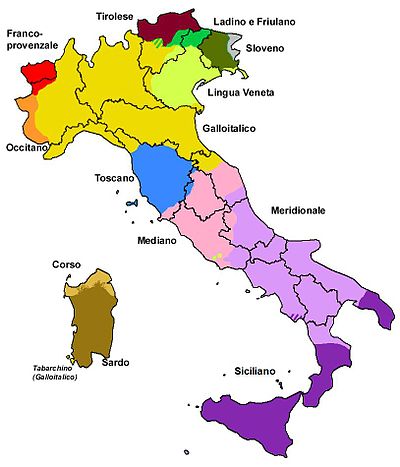

Romance languages
Gallo-Italian
- Emiliano-Romagnolo
- Emiliano
- Romagnolo
- Ligurian
- Tabarchino
- Lombard
- Western Lombard (sometimes also called Insubric or Cisabduano: Lombardo prealpino occidentale, basso Lombardo occidentale, Macromilanese)
- Eastern Lombard (sometimes also called Orobic or Transabduano: Lombardo prealpino orientale, basso Lombardo orientale)
- Intermediate Western-Eastern dialects (Lombardo alpino)
- Piedmontese
- Venetian
Gallo-Romance
- Standard French
- Franco-Provençal
- Faeto
- Valdôtain (Valdoten)
Ibero-Romance
- Catalan
- Algherese
- Occitan
- Provençal
Italo-Dalmatian
- Italian
- Tuscan - the base of Standard Italian
- Central Italian
- Corsican
- Neapolitan (Inner Southern Italian)
- Neapolitan of Campania
- Abruzzese
- Molisano
- Lucano dialect
- Pugliese of northern and central Puglia
- Northern Calabrian (Cosentino)
- Sicilian (Extreme Southern Italian, possibly Southern Romance)
- Sicilian of Sicily
- Salentino of southern Puglia
- Southern Calabrian
Judeo-Italian
- Italkian (Jewish language form; term coined in the mid-20th C. Spoken by a small minority of Jews in Italy.)
Rhaeto-Romance
- Friulian
- Ladin
- Nones
- Solandro
Southern Romance
- Corsican (considered to be related to and mutually intelligible with Standard Italian)
- Gallurese (considered by some authors as a variety of Sardinian, by some others an independent language)
- Sardinian
- Sardo campidanese
- Sardo logudorese
- Sardo nuorese
- Sardo arborense
- Sassarese (considered by some authors as a variety of Corsican, by some others a variety of Sardinian)
Albanian language
- Arbërisht#Shqip
Germanic languages
- Standard German
- Bavarian
- Cimbrian
- Tyrolean
- Walser German
Greek languages
- Griko
Indo-Iranian languages
- Rom
- Sinti
Slavic languages
- Molise Croatian dialect
- Slovene
- Resian dialect